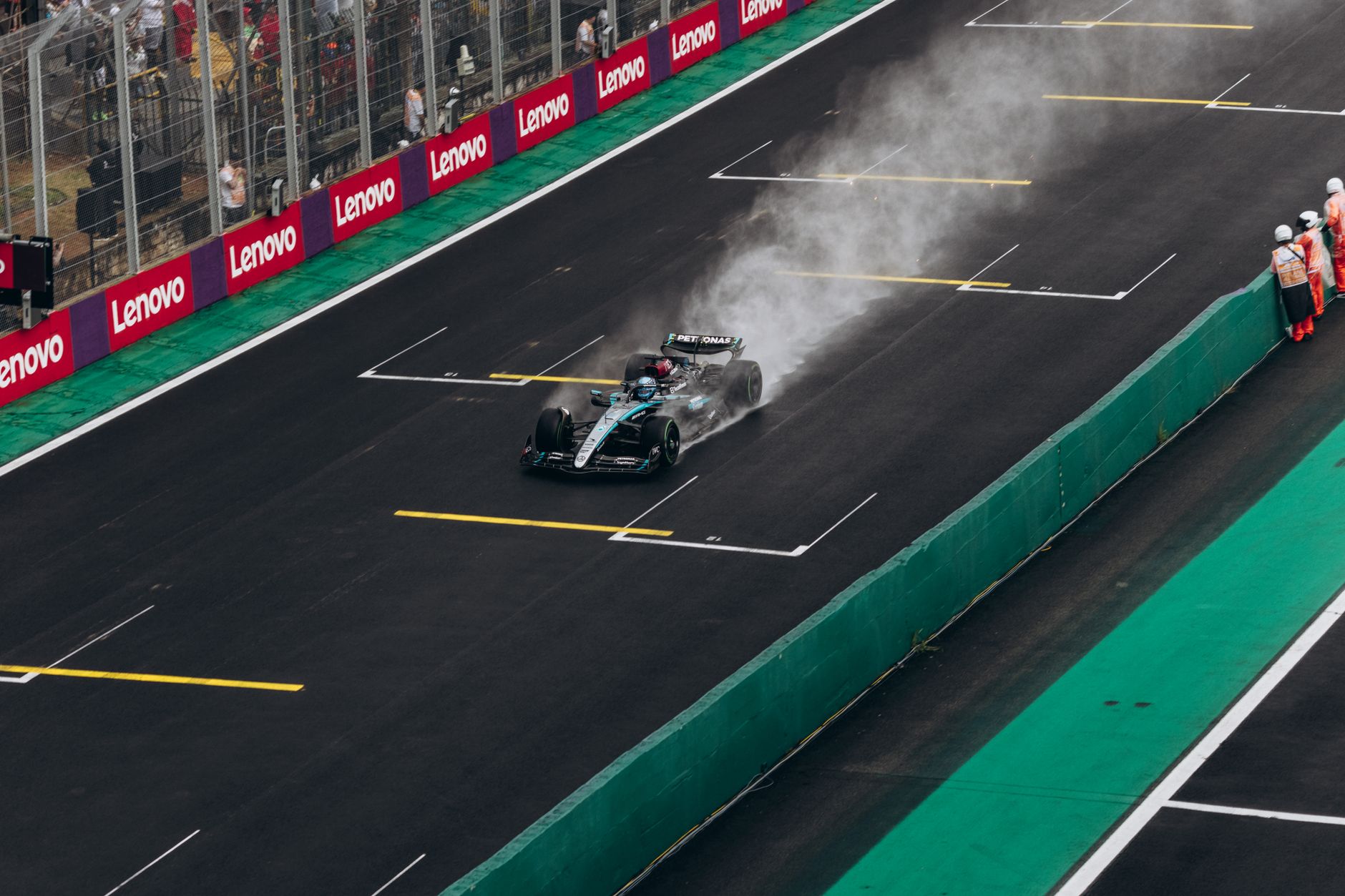
George Russell will start the Canadian Grand Prix from pole after a late Mercedes strike in Montreal.
Russell delivered a 1:12.578 at the end of qualifying, beating team-mate Kimi Antonelli by just 0.068 seconds. It completed a Mercedes front-row lockout and put the team in control of the race start.
Lewis Hamilton qualified fifth for Ferrari and kept that place after a post-session FIA review into a possible impeding incident involving Pierre Gasly. That matters because a grid drop would have changed the sharp end of the Sunday order.
The confirmed front of the grid is clear. Russell starts first, Antonelli second, Lando Norris third and Oscar Piastri fourth. Hamilton and Max Verstappen share the third row, with Isack Hadjar and Charles Leclerc behind them.
That makes Canada a Mercedes versus McLaren launch, with Ferrari and Red Bull close enough to attack if the race becomes messy.
Mercedes Finds The Last Lap
This was not a simple pole for Russell. Q3 looked open until the final seconds.
Norris held provisional pole after the first runs. Hamilton also looked close enough to threaten the front. Antonelli then found a 1:12.646 and appeared to have done the job for Mercedes.
Russell had other ideas. His final lap arrived late, clean and decisive. Around Circuit Gilles Villeneuve, that takes nerve. The lap has long straights, heavy braking zones and walls waiting at the exits.
A driver cannot build a lap slowly there. He must trust the front tyres into the chicanes, attack the kerbs, then avoid overstepping by a few centimetres.
The result gives Mercedes track position on a circuit where the first braking zone can shape the race. Pole position means Russell controls the launch and the run into Turn 1. Antonelli alongside him gives Mercedes a second shield against Norris.
It also creates a live team dynamic. Russell and Antonelli had already been central to the Sprint story, and now they start together again. Mercedes will want a clean first corner more than a private duel.
Hamilton Case Ends Without A Grid Drop
The Hamilton story moved from uncertainty to clarity after qualifying. The FIA investigated whether Hamilton had impeded Pierre Gasly during Q1.
Impeding means holding up another driver who is trying to complete a timed lap. It can bring a grid penalty if stewards decide the driver blocked unnecessarily.
Hamilton was under scrutiny because Gasly came across him while the Ferrari driver was preparing his own tyres. Drivers often weave and slow on out-laps to heat the rubber before pushing. The problem comes when another car is already on a fast lap.
The stewards took no further action, so Hamilton keeps fifth. That keeps Ferrari on row three beside Verstappen rather than dropping the seven-time champion into traffic.
The public talking point is obvious because Hamilton had already attracted steward attention during the Sprint. The confirmed sporting point is narrower. There was an investigation, but no grid penalty followed.
For Ferrari, fifth is still useful. Hamilton was within three tenths of Russell’s pole time, and he had looked like a pole contender earlier in the session. But Ferrari missed the front-row fight, while Leclerc ended up eighth after a difficult qualifying.
That leaves Ferrari with opportunity but little margin. Hamilton can attack Verstappen at the start, yet he also has Hadjar and Leclerc close behind. A compromised opening lap could turn a strong grid slot into a defensive race.
Tyres Made The Session Nervous
The main technical theme was tyre temperature. Several drivers struggled to bring the front tyres into the right working range.
In simple terms, an F1 tyre needs heat before it grips properly. Too cold, and the car slides. Too hot, and the grip fades. Montreal’s stop-start layout makes that balance tricky because drivers need confidence under braking and traction over the kerbs.
Verstappen struggled with front tyre warm-up in Q2 and still reached sixth. Hadjar, in the other Red Bull, briefly raised the stakes by topping Q2 with a 1:12.975. That was one of the session’s sharper surprises.
Hadjar then qualified seventh, only 0.028 seconds behind Verstappen. That is a strong Red Bull intra-team marker on a weekend where the senior car did not look fully settled.
Behind them, Arvid Lindblad put Racing Bulls ninth and Franco Colapinto placed Alpine tenth. Both made Q3 while more experienced team-mates missed out, which gives the midfield part of the grid a fresh edge.
Nico Hulkenberg was 11th for Audi, ahead of Liam Lawson and Gabriel Bortoleto. Gasly took 14th for Alpine, with Carlos Sainz 15th for Williams and Oliver Bearman 16th for Haas.
Q1 removed Esteban Ocon, Alex Albon, Fernando Alonso, Sergio Perez, Lance Stroll and Valtteri Bottas. Albon’s weekend had already been damaged by a marmot strike in practice, while Aston Martin and Cadillac also had post-session matters around pit-lane and race director instructions.
Those investigations add paddock noise, but they do not change the main race question. Can Mercedes convert a front-row lockout into a Grand Prix win?
Rain Could Change The Race
The teams qualified with a dry track, but Sunday may ask a different question. The rain risk was above 40 percent, and the FIA had declared a rain hazard for race day.
That does not guarantee a wet race. It means the event has a meaningful weather risk, and teams must prepare for wet-weather procedures and changing grip.
This matters because cars are under parc ferme conditions after qualifying. Parc ferme limits what teams can change before the race. If a team tilted its setup toward dry qualifying, it may pay a price in rain.
Wet conditions would also reduce the value of pure grid order. Visibility drops, braking zones stretch, and tyre choice becomes decisive. Drivers may need intermediates, full wets or slicks depending on how quickly the track changes.
The Canadian Grand Prix is scheduled for 16:00 local time on Sunday. For viewers in India, that is 1:30am IST on Monday.
Russell has the cleanest view into Turn 1. Antonelli has the inside chance to challenge. Norris and Piastri start close enough to punish any Mercedes hesitation.
Hamilton’s cleared investigation removes one uncertainty from the grid. The weather may add several more before lights out.