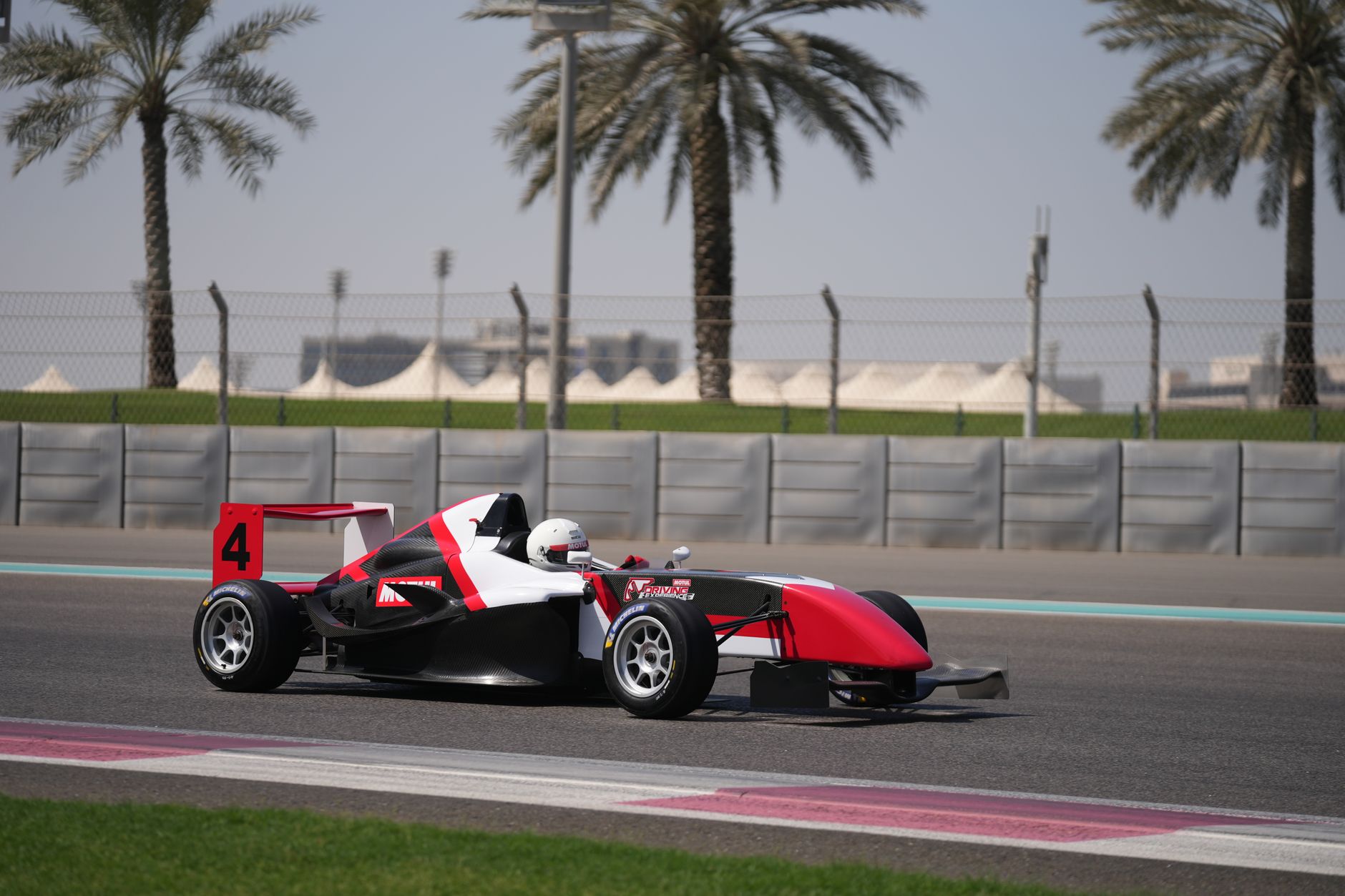
Lewis Wherrell claimed his first British F4 victory with a controlled lights-to-flag drive at Snetterton.
The JHR Developments driver converted pole into the race lead, survived a safety car restart, then built a 2.048-second winning margin. He also set the fastest lap, a 1m50.229s, to underline the pace behind his breakthrough result.
For a young driver in British F4, that matters. A maiden win is more than a result on a timing sheet. It proves a driver can manage the start, control tyre temperature, handle a restart and close out a race with pressure behind.
Wherrell did all of that in the opening race of the weekend.
The race ran for 10 laps and lasted 20m52.797s for the winner. Scott Lindblom finished second for Hitech, while Dries Van Langendonck took third for Rodin Motorsport after spending the second half of the race attacking Lindblom.
Van Langendonck still left the opener with a strong championship position. He sits on 100 points, ahead of Ethan Jeff-Hall on 66 and Lindblom on 60. Wherrell’s win places him fourth on 55, with Joseph Smith close behind on 51.
That gives the result two layers. Wherrell got the emotional headline. Van Langendonck still protected the title picture.
Wherrell’s launch set the tone. He made a clean getaway from pole and held the lead into the opening sequence. That is often the most important job at Snetterton, where early rhythm can decide the race before the field spreads out.
Behind him, Van Langendonck made immediate progress. He passed Theo Palmer to take third, placing himself behind Lindblom and in range of another podium.
The fight behind the leader soon became the main story. Wherrell had track position, clean air and enough pace to control the first phase. Lindblom and Van Langendonck had to think about each other, not just the leader.
That distinction is important in junior single-seaters. When two drivers battle, they lose time through defensive lines, compromised exits and dirty air. The leader can then run the best racing line and protect tyre life.
Wherrell used that situation well.
The opening lap also brought trouble further back. Tommy Harfield was fighting near the edge of the top 10 when Timo Jungling tried to get alongside at the first corner. The pair made light contact, but the impact sent Harfield wide over the grass and into the barriers.
Kit Belofsky also hit problems at the final corner. He damaged his front wing and nearly collected Henry Mercier as he moved across the track. Belofsky and Mercier both came into the pits for repairs.
Mate Kobakhidze then stopped on track, adding to the early disruption. Race control brought out the safety car so marshals could clear Harfield’s car.
A safety car bunches the field. It removes any time gap built by the leader and gives drivers behind another chance. For Wherrell, it meant doing the hard part twice. He had already nailed the start. Now he had to control a restart with eight minutes remaining.
He handled it cleanly.
When racing resumed, Van Langendonck attacked Lindblom straight away. That helped Wherrell. The second and third-placed drivers focused on position, while the leader opened the gap.
Van Langendonck kept pushing, but Lindblom held firm. The Hitech driver’s defence secured second place and valuable points. Van Langendonck had to accept third, 2.789s behind Wherrell at the flag.
The podium still worked for all three drivers in different ways. Wherrell banked his first victory and fastest lap. Lindblom strengthened his championship total. Van Langendonck added another podium to his title-leading campaign.
Smith finished fourth for Virtuosi Racing, 3.888s off the winner. George Proudford-Nalder took fifth for the same team after resisting Palmer late on. Palmer finished sixth for Hitech, 5.394s behind Wherrell.
Ethan Lennon completed the top seven for Rodin Motorsport. Jeff-Hall came eighth for Argenti Motorsport, keeping second in the standings despite a quieter race. Adam Al Azhari finished ninth for Hitech, while Jarrett Clark took the final top-10 position for Virtuosi Racing.
That top 10 spread across several teams. JHR won the race, Hitech placed three cars inside the top nine, Virtuosi put three drivers in the top 10, and Rodin had two inside the top seven.
It shows the depth of the British F4 field. It also shows why qualifying and starts carry so much weight. When the front pack runs closely, clean track position can be worth more than a small pace advantage.
For Indian and global fans tracking the F1 ladder, British F4 remains a useful form guide. It is not Formula 1’s direct feeder championship, but it is part of the early single-seater path. Drivers learn racecraft, car control and pressure management before moving toward categories such as GB3, Formula Regional, F3 or other international routes.
That makes Wherrell’s race worth attention. A first win does not define a career, but it can change a season. It brings confidence, establishes credibility in the paddock and gives teams a clearer reference point.
The fastest lap adds extra weight. Wherrell did not simply inherit victory through chaos. He controlled the race and had the peak pace to match.
The championship table still favours Van Langendonck. His 100 points give him a 34-point cushion over Jeff-Hall. Lindblom is six further back, with Wherrell five behind Lindblom.
That keeps Wherrell in the chasing pack, not yet in control of the title race. But after Snetterton’s opener, he has a result that changes how rivals must treat him.
For Lindblom, second place was also important. He could not match Wherrell’s race-winning execution, but he resisted sustained pressure from Van Langendonck. That sort of defence can matter later in a championship, especially when points tighten.
For Van Langendonck, third was a practical result. He attacked when the race restarted, but he avoided a costly move. In a title fight, forcing a pass is useful only when the risk makes sense.
The retirements told a different story lower down the order. Harfield, Kobakhidze and Mercier did not finish. Belofsky reached the flag in 24th after his early repair stop, 22.069s behind the winner.
Those results hurt in a points-based junior series. One non-score can shift momentum quickly, especially across a busy weekend format.
Snetterton’s first race therefore delivered a clean headline and a fuller championship subplot. Wherrell finally converted front-row promise into victory. Van Langendonck still leads. Lindblom remains in the fight. Jeff-Hall stays second despite finishing eighth.
The weekend now has a sharper edge. Wherrell has proved he can win from the front. The next question is whether he can repeat that standard when the grid, traffic or strategy picture becomes less straightforward.